
I am very excited to write this post about my Operational Case Study (OCS) exam experience so hopefully those of you who have yet to sit for the OCS can get a better idea of what to expect, how to prepare and ultimately pass the OCS and move up to the Management level. I sat my very first CIMA Case Study exam on May 10th 2019 and, as I’m writing this post, I am nervously awaiting my results that are due to come out in exactly 12 days on June 20th. Going into the exam, I felt terrified by the OCS exam format. For most CIMA students, the case study presents a challenge since the exam formula is so much different from a traditional testing experience. Speaking from my own experience as an accounting major at a university, the most common form of testing I have encountered is in form of multiple choice questions or a one-off complex accounting problem to solve. I have also done essays, reports, group work, quizzes and presentations for my accounting classes but none of these came close to the CIMA Case Study format. On top of that, if the exam formula isn’t enough to scare you, the amount of revision material from E1, P1 and F1 will definitely cement the fear. In order to conquer the exam anxiety and successfully pass the OCS it is key to first understand that the Case Study is a very unique exam in that it aims to test whether you can apply accounting and business knowledge to a company modelled on a real life company based in an actual existing industry. Essentially, the Case Study ensures that as a Certified Global Management Accountant you will be able to add real value at the place of your employment. Think of it this way: anybody can memorize a textbook from A to Z and practice enough similar question problems to pass the Objective Tests (OTs), but not everybody can make use of the right information, at the right time, in the right context and use it in a way that adds value. For this reason, I am going to share my OCS exam experience and OCS tips in hope that you find them helpful in your case study preparation. I definitely wish I knew these things before I went into the exam so if you are still reading here, you are about to gain valuable insight from someone who just did the OCS. I also think it would be interesting to share my thoughts before and after the results are released to see if my impressions change so expect a follow up on June 20th in which I will reveal whether my predictions were accurate.
*Disclaimer: the CIMA Code of Ethics is binding for all students as well as members and as a reminder- its fundamental principle is confidentialty. For this reason I purposely left out the actual exam content that appeared in my variant and I will not comment nor respond to questions relating to any specific information I have encountered in my OCS exam. Also, bear in mind that what I mention below is my personal opinion and should be taken as such.

My tips on OCS revision
There are multiple guides on OCS prepartion on CIMA’s and other tuition providers’ websites so I decided I will not clutter the internet with the same information. Instead, I chose to share below some specific steps I have taken to prepare and reflections on how I would go about studying if I had to take this exam all over again.
Time management and planning is key
This is a critical point that I wish I grasped sooner than a couple weeks before my actual exam. Do not delay case study revisions as the more time you have on your hands the better you can prepare. In my case, due to my university and other personal commitments I actually haven’t started preparing until only 4 weeks before my actual exam! Given that the pre seen for May 2019 was made available around 7 weeks before the testing window, I missed out on 3 weeks of valuable study time that could otherwise allow me to spread my work more evenly and save me that last minute stress. So in sum, even if you are bombarded with competing priorities- as soon as the pre seen is released read through it and plan your study accordingly. Even if you don’t start preparing until later on, you will already have a solid idea of what general issues or opportunities the pre seen company is facing and perhaps next time you read financial news a relevant topic will catch your eye. Read through the pre seen every night before bed time and familiarise yourself fully with your role, the company and the industry. I promise you will be much more comfortable in the actual exam and will save yourself valuable time if you avoid going back and forth between the preseen and the response window.
First: Familiarise yourself with the exam structure
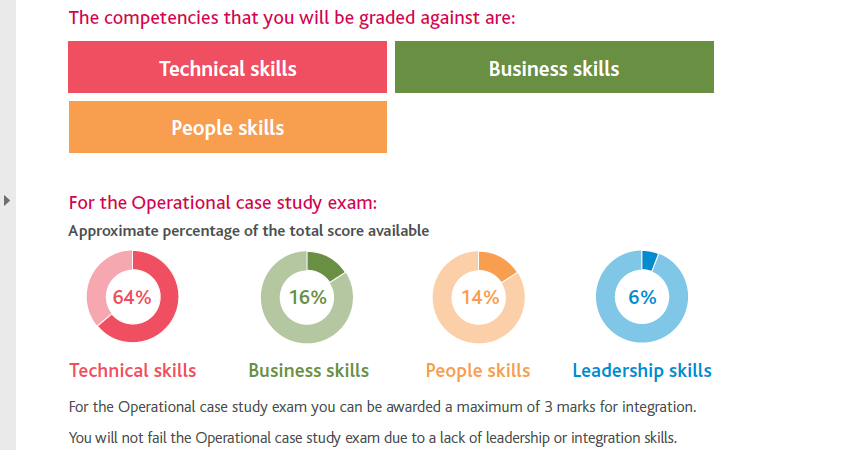
As I mentioned above, at first the exam structure appeared confusing and I didn’t even know where and how to kick start my study process without fully understanding the exam format. I went to CIMA’s website and downloaded anything I could get my hands on. I also got Kaplan’s OCS guides and signed up for multiple webinars including VIVA Financial, Astranti and Kaplan. The guides help you understand terminology such as: scene setting, trigger, task and what that means in the context of the OCS. You will also learn about how the Case Study is graded which at the Operational Level is 64% technical, 16% business, 14% people skills and 6% leadership (differs marginally between variants). Don’t focus too much on these competencies but rather use it as a way to understand what components should be allocated most of your revision time. Also, familiarise yourself with the time limit for the exam to avoid any surprises. As a reminder, OCS is a 4h long exam with no scheduled breaks, composed of 4 parts alloted varying amounts of time from simply 45 minutes each, to odd combinations such as 54, 36, 40 and 50 minutes. There are usually 5 different variants for each case study testing window and each of these variants could have a different time combination for the consituents. Nevertheless, don’t waste your time guessing which variant or what time combination you are going to get- it is a pure lottery.
One thing to have in mind is that if you are short on time, don’t get too hung up on the numerous OCS guides and webinars. In my case, I was so confused about the exam structure I told myself I needed weeks to be confident to tackle this exam. Needless to say, I burned through 2 weeks of my 4 weeks available time. That’s half of the time I allowed myself to study so at this point I knew I had to act quickly and change my strategy. Instead I spent the last 2 weeks strictly on technical material revision, pre seen work, mock exams and past paper reviews.
Revise the technical material
At the Operational Level, technical skills are alloted 64% of the overall grade making it the biggest indicator of a pass or fail. I can’t stress that enough but you need to be very comfortable with the topic materials across all 3 pillars at this level and you simply cannot afford to lose all these points if your goal is to get a pass. Remember that the case study is compared to a race against time for a reason. In the OCS exam, you are required to read through the trigger and task, analyse any attached documents, plan and produce a meaningful answer on a complex subject and finally if you are lucky enough to have time left- format and check your answer for grammar and spelling mistakes. Given this time limit, you have to be very agile and comfortable in applying your theoritical knowledge. There is simply no time to sit and ponder what IAS 2 provisions were about, how the material mix variance was calculated or how to interpret that limiting factor analysis from the attached schedule. Trust me, if you dedicate your heart to revising technical material it will give you a very solid foundation to tackle the OCS. The good news is that you will not be asked to perform any calculations, however you might be presented with graphs, reports or analysis and you will need to quickly derive how the figures are calculated or what they mean in the context of your company and the given trigger.
As I mentioned before, because of my poor time management I was left with 2 weeks for all my revisions. The intensity and amount of material revision that you will need to do largely depends on how much time has passed since you took your OTs. In my case, I took F1 and P1 in January that same year, and E1 a month later in February. Even though it has only been on average 3-4 months between my OTs and the Case Study I already forgot lots of details. Try timing your case study closer to your OTs so you are very fresh with the material and only have to do minimum revision. However, if you are in the same boat as I was, revise the material in depth, including the question problems. As I studied for E1, P1 and F1 I have kept organized and detailed notes so I simply went over all of them without skipping any part. When I practiced for OTs with a question bank, I took notes of the solutions for multiple choice questions so I also went over each of the question problems carefully, making sure I understood how a certain model was used or how a certain number was calculated. Being rigorous and meticulous in the revision process is critical as you don’t know what subjects the OCS will test on. Revise the entire material and be honest with yourself- if you don’t understand a topic, revise it over and over again until you understand it. All in all, it took me about 4-5 days to go over my notes and at that point I felt confident in my ability to recall the theory. If you are not a note taker, go over your tuition provider materials, the textbook, question banks, lectures and videos*. Ultimately, the goal to be as fresh and comfortable with the technical material as you were on the E1, P1 and F1 exam days so whatever method works for you best-continue with it until you feel comfortable.
*some of my recommended study materials are CIMAstudy, Kaplan Study Texts and Practice Kits.
Know the pre-seen in and out
The next critical factor is knowing the pre seen material in and out. Read over the pre seen at least 5 times and every time you read pick up more signs about the company and its relevant problems. First, read the entire material and get an overall picture of the company. Then read the pre seen again and pick up more specific details. A SWOT or PESTEL analysis can help you at this point. Once you get to the financial report try to notice a pattern within the numbers. Calculate year over year movement of items such as revenue, gross profit, cost of sales and operating profit. Derive accounting ratios such as gearing ratio or working capital cycle. Now that you have done a more in depth analysis, read the pre seen once again and link the information provided to your analysis. For example if the pre seen mentions that the company operates in a volatile industry and through your analysis you derive that the company has poor gearing and a decrease in liquid assets, you may identify possible insolvency issues. After you read the pre seen in light of any new information you concluded, go back to it regularly e.g. every day before your actual exam. You can only store so much information in your short term memory so reading the pre seen over and over again helps to refresh things in your mind. Additionally, as you are getting more familiar with the pre seen, try to think of any real life experiences you have had with the particular industry. In my case, May 2019 pre seen concerned a company called VitaMine, a South East Asian vitamin, mineral and supplements manufacturer. When I got more familiar with the pre seen I paid more attention to news about the VMS industry as well as recalled my personal experiences as a customer myself shopping at websites such as iHerb.
There also numerous study materials on the market that are designed to help you familiarize yourself with the company at hand. I have used Kaplan’s Familiarisation and Practice Workbook for May 2019 Case Study and found it to be a great tool to dissect the pre seen material and notice issues that otherwise I wouldn’t pay much attention to. In addition to the pre seen practice, the workbook offers more case study style sample questions for each technical pillar E, F and P. There is also a great number of free webinars, blogs and youtube videos that often get recommended by CIMA and I personally found Kaplan’s, Astranti’s and VivaTuition’s webinars very informative.
Go through as many mock exams and past papers as you can
Once you have completed your technical material revision and read through the pre seen multiple times, attempt mock exams and read through the past papers. I found that this excercise particularly teaches you how to effectively combine the pre seen and technical knowledge in a form required by the Case Study.
Mock exams are often available through tuition providers such as Kaplan, Viva Tuition, Astranti or BPP. I got 3 Kaplan mocks for May 2019 case study and only managed to attempt 2 of them under exam conditions. I then had them checked by my tuition provider and I was advised on the strong and weak points of my answers. Looking back, I wish I managed my time better to attempt at least 3 full mock exams instead of 2 but ultimately any mock exam practice will give you significantly more confidence. Many mock exams are prepared by tuition providers with years of experience teaching CIMA case study and often you will see that the questions given in mocks will address the company specific issues from the pre seen. Sometimes you may be asked a similar question on your real exam, but since the OCS is obviously a lottery, if you are not tested on similar issues, the mocks still provide excellent practice to further understand and consolidate your overall understanding of the company from the pre seen. Two days before my exam, I also accessed 2 official CIMA mock exams from Pearson Vue’s practice exam catalogue however I found that those were not specific to May 2019 pre seen instead they were a past case study variant from a couple years ago. I wouldn’t waste my time fully attempting a mock that doesn’t relate to my specific pre seen but I recommend going over the mock to look how the screen is laid out. It is the only mock exam that looks like the real exam so it is helpful to see where the tables, the clock and the notepad are located as well as how to navigate between 2 or 3 screens in the OCS tasks. It certainly helped me feel more prepared and know what to expect from the real exam screen.
Next, read through as many past papers as you can find. I was lucky enough to get access to 9 past papers, each having 5 variants giving me 45 different examiner’s reports to study. The papers were fairly recent and ranged from February 2017 to February 2019. By the time I finished revising technical material, studied the pre seen and completed Kaplan’s Familiarisation and Practice Workbook I only had 4-5 days left for both mock exams and past papers. Going through 45 examiner’s reports was therefore unrealistic but I still managed to get through around 20 reports. The examiner’s report and suggested answers not only give you an idea of the technical material that is heavily tested (e.g. variances, quality issues, working capital management) but also help you understand what CIMA examiners are looking for in a perfect answer. Note how the suggested answers are structured, what kind of language is used throughout (formal, informal) and what level of detail the answer goes into. In the OCS you will be given the role of a Finance Officer and depending on who you are addressing (internal, external, level of seniority), the language used and the level of detail and complexity may differ. Eventually, I don’t think it’s critical to go over 45 examiner’s reports but as a rule of thumb, the more papers you read, the better you are equipped to produce a strong answer in the OCS.
Lastly, practice under exam conditions. On the real exam, once your time for the section runs out you are going to be automatically taken to the next screen. When practicing at home, try to immitate the exam conditions as closely as possible so when the time runs out you stop writing and proceed to the next task. I found this technique to help my time management in the real exam. Timing yourself equips you with an ability to better manage your time by staying concise, focusing on 2-3 key areas and exploring them in just a few sentences. The first time I attempted a mock exam, I took 1 hour and 20 minutes for my first task that was alloted only 54 minutes. Being 26 minutes over the time limit, I knew I would have failed the task on a real exam. Hence, I changed up my strategy going forward and managed to stay within the time limit for the remaining 3 out of 4 tasks. Afterwards, I glanced frequently at the clock while doing my mock exams and managed to stay within the alloted time limits.
Another tip is to measure your typing speed using a free typing speed test. CIMA indicates that 20 words per minute is the average sufficient speed for the OCS however I strongly advise you to measure your typing speed and try to increase it because the OCS really is a race against time. On average 45 minutes seems long but given the numerous requirements that you are given and the time consumed to just read and analyse attached schedules, fast typing is a necessary skill to maximise the use of your time. Also, if you are used to a laptop keybord you might want to practice with a full PC keyboard like the one in the actual exam. I praticed in the public library the day before my exam just to feel more confident about my typing speed, since I mostly use a compact laptop keyboard and was afraid my typing speed would be slower on a regular PC keyboard.
Finally, this might seem self explanatory but try not to snack, drink, use the restroom or use your phone while doing your mock exams. In the real exam, snacking, drinking or phone use are not allowed, and while you can leave the examination room to use the restroom, I do not recommend it as you will lose too much time and again OCS is a race against time. Even though it seems straightforward, something as trivial as being hungry and not being able to focus or having to go use the restroom and losing too much time may decide whether or not you are going to fail the exam so definitely make sure to plan ahead and keep that in mind when you practice.
How did the exam experience differ from my expectations?
Now that you know my study process you must be wondering whether it actually worked on the exam day. Here are my conclusions:
- My technical material revision technique worked. Taking detailed notes for my OTs turned out to be a lifesaver and thanks to these detailed notes I was able to revise a huge amount of study material in a very short time. I can’t disclose what my exam tested on specifically but all I can say is that I was very familiar with the issues that came up and overall I felt confident about my technical knowledge in the tested areas.
- Faimiliarity with the pre seen helps tremendously. I found that in the real exam I had no time to go back and forth between the pre seen window and the answer window.
- Follow a proper structure from the very beginning. I think this tip alone can save you a lot of time that you would otherwise waste on last minute formating. Practice producing answers using the proper layout and writing style and then closely follow that structure in the actual exam.
- Time management practice was key in my opinion. The 4 hours in the examination room truly felt like a race against time. I was hungry and thirsty but there was simply no time to think about anything else other than the task at hand. I found that in some tasks I managed my time better and was able to edit and check my answer however in one of my tasks, I ended up almost running out of time and was still typing my last word with 0:05 seconds left. In that particular task, I didn’t have time to even check for grammar and spelling mistakes which still makes me nervous as I anticipate my results. In conclusion, I think that learning how to manage your time in the OCS is crucial and I wish I practiced my time management more by doing additional mock exams.
- My last conclusion is that the OCS truly is a lottery. When people advise you to not waste time guessing what questions are going to come up, they are right. The possibilities for testing are vast. You may be faced with additional material that completely changes the situation of the company or contrarily, the case study will follow a close path from the pre seen. Be flexible and accept that there is no clear way to tell what is going to be tested.
Did I pass or fail? Awaiting the results.
I nervously await the score release on June 20th and since this is my first ever CIMA case study experience I don’t know what to expect yet. I don’t want to be overly confident, but at the same time I’m leaning more towards a pass. Another consideration is how many points I scored in each of the competencies. I don’t attempt to guess this one as I’m not even 100% sure how these points get allocated.
At this moment, all I have left to do is to patiently wait but I find myself checking my CIMA account all the time out of curiosity despite knowing that the result won’t be there until 12 days from now. My exam results window currently looks like this:
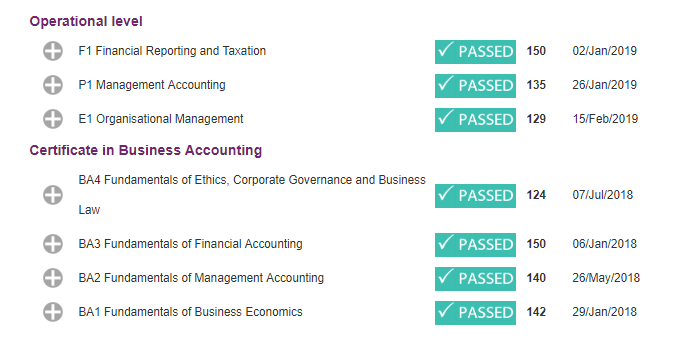
As you can tell there is no case study result yet and I assume it’s going to appear in the same window as well. I’m going to follow up with another post after getting my results back. I think this would make for an interesting comparison of my impressions pre and post score release. Perhaps I completely fail and will find out that my technique didn’t work at all. Anything is possible at this point but I’m excited to share this journey with fellow CIMA students.
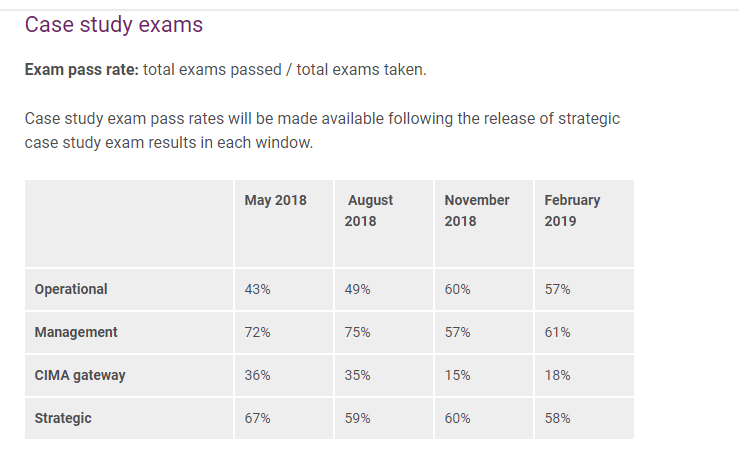
To wrap up this post, I wanted to quickly comment on why my perception of the Case Study exam changed after I took it. Like most students, I dreaded this exam having heard of its difficulty and seeing a very low pass rate ranging from as low as 43% to as high as 60% (total exams passed/total exams taken).
However, having taken my first ever Case Study exam, I am now excited to move to the management level and challenge myself again in the Management Case Study. I personally think it is a lot of fun to apply what you know to a company modelled on a real existing business. Additonally, with the ever increasing job automation I think the case study is a unique examination in that it tests on skills that are not likely to be replaced by AI. Technical material, especially tedious calculations can be easily automated but skills such as multi factor analysis, linking numbers and subjective judgement, communication and leadership in the context of the accountancy profession are much harder to replicate and are the very skills that will give accountants a true competitive advantage in the near digital future.
I hope you found this lengthy post informative and if you have any more CIMA specific topic suggestions I’m glad to consider them and share my perspective. Feel free to leave your comments below and I will try to respond promptly to any questions that you may have.

 Pass Your Accounting and Finance Exams
Thanks for sharing, really informative and extremely helpful.
My fear as CIMA student and the OCS is I have the E1 objective test remaining but my exemptions for F1 and P1 are from many years ago so my knowledge has diminished on these topics through time.
LikeLike
Hi Paul, thanks for your feedback.
Thankfully, P1 and F1 changed marginally so the 2019 syllabus tested is almost the same as 2015. E1 is the one that has changed the most but that shouldn’t be a problem since you study with the new syllabus. You may want to check the transition guides for the 2019 syllabus that CIMA published at https://planner.cimaglobal.com/articles/transition-guides.
If you are short on time, once you get E1 out of the way, brush up on core topics in P1 and F1 using online resources like OpenTuition notes. Key technical topics tested in my opinion are still:
-know variances inside and out
-revise the general provisions of IAS and IFRS within F1 (pay attention to changes over the last years)
-be comfortable analyzing basic risk assessment scenarios e.g. decision tree
-advise on budgeting and management issues e.g. read a break-even chart or limiting factor analysis
-people and technology topics in E1- know how to apply to pre-seen
Good luck in your OCS exam!
LikeLike